The Shape of Enough: How chronic illness taught me what my money is for
You would never guess it from meeting me, but even on good days part of me is constantly monitoring my energy, mood, and pain levels. Is that the first hint of a migraine? Why does everything suddenly feel harder than it did yesterday? Is this just a rough day or the beginning of another cycle? This self-surveillance is like a computer program that runs constantly in the background, slowing everything else down. This is life with chronic health conditions. I’ve never considered myself disabled, despite living with conditions that qualify as disabilities under the Americans with Disabilities Act. For most of my life, the effects were episodic enough that life was pretty normal, busy with commitments to friends, travel, and other interests. As I entered my late 30s, something changed. My symptoms worsened considerably. Brain fog and a bone-deep fatigue that never went away, no matter how much I slept at night, became constant companions. Even on days when things were pretty good, managing the flare-ups consumed so much energy that I had little mental, emotional, or physical capacity left for anything else.
The Breaking Point
By the time mid-2023 rolled around, I reached such a low that the part of me that always insisted I keep going finally relented. I took a three-week leave from work, and by the end of that time, the brain fog began to lift and the constant anxiety eased. I returned to work feeling like I could see a light at the end of the tunnel, a way back to myself. However, upon my return, I was mired in a demoralizing conflict over whether this break qualified for use of my employer’s unlimited sick leave policy.
It felt so humiliating because I had tried so hard to not need help. I spent my 20s and 30s trying to tame and discipline my body. I wondered why it was that I struggled so much with what many others seemed to do with ease. Was I lazy, spoiled, too sensitive? Did I just need to suck it up? How come long weekends and one-week vacations didn’t restore me, but just brought the fact of my exhaustion into relief? I sought cures—Western medicine as well as alternative therapies. As I turned the corner into my forties, the surveillance system was fully inside of me, policing every deviation and rejecting anything other than a complete return to the capacity and clarity of just a few years earlier. I was a consummate masker, able to pretend everything was fine—until suddenly, I couldn’t anymore. The willingness to take a break was born of total desperation. Never before had I been so vulnerable. Never before had I revealed so much about myself. Never before had I asked for so much support and care. My employer’s questioning of my right to use our sick leave policy felt like a humiliating invalidation of the self I had just dared to reveal.
The Privilege of Choice
Many people in similar positions, facing this narrowing squeeze, dream of a life that affords them the autonomy to spend their time and energy in ways that enable rather than enfeeble them. Yet very few have the ability to escape it in the ways I can. A year and a half after the fight over sick leave use (which was eventually approved), my role was redesigned into something that felt far beyond my capacities and interests, while also providing less financial benefit. And so I chose to leave, enabled by an inheritance from my mother to make choices that prioritized my whole well-being rather than just survival. The strangeness of using capital to buy freedom from a system that measures human worth through productivity isn’t lost on me. I can’t quite square it. I’m left feeling both deeply grateful—and deeply uncomfortable and angry that the freedom available to me isn’t more widely available.
People with Disabilities Deserve Better
The reality is that many people dream of having enough autonomy to organize their lives around the needs of their bodies. Yet our social safety net often makes that extraordinarily difficult. Federal disability programs provide essential support, but they frequently do so in ways that force people into impossible tradeoffs. Asset limits, income restrictions, and benefit cliffs can make it difficult to save money, build a household, pursue employment, or marry without risking access to vital benefits and healthcare. Many workplaces remain reluctant to provide meaningful accommodations, while the erosion of remote work options has removed a critical source of flexibility for many disabled people.
The result is a system that often requires people with disabilities to remain economically vulnerable in order to qualify for support, while simultaneously encouraging them toward independence and self-sufficiency. I can’t tell the story of my own path to freedom without noticing how many others are denied access to the same possibilities. It shouldn’t take an inheritance to organize your life around the realities of your body.
For readers interested in disability policy reform, here is a link to pending legislation addressing SSI asset limits and marriage penalties. I encourage you to write to your senator and representative to support these efforts.
Finding Myself Again
Today, I am more able to clearly articulate and understand what was just beginning to emerge when I left full-time work. In the past year, I have earned tremendous dividends for my health, energy, and mental clarity. It hasn’t “fixed” me. I am still in chronic pain. I still struggle with mental clarity and focus. I still require medication to manage neurological, neuroendocrine, and mood disorders. But the removal of full-time work has brought a slower pace of life, allowing me to take better care of myself. Less fatigue at night means I have energy for my physical therapy practices. My migraines have improved because I can control my screen time. I’ve been able to reduce some medications and entirely stop others. I no longer wake up in the morning with a sense of crushing fatigue. With overall improved health, I am rediscovering capacities and parts of myself that had been crowded out by survival. The biggest gift? About halfway into the year, I began writing again. I find that I once again have the mental clarity to have something to say and the energy to say it. I thought this part of me was totally gone, and rediscovering and connecting with all of you has been such an unexpected gift.
What is Money For?
As this new life has taken shape, I find myself settling around an understanding of “What is my money for?” My money is for creating a condition where the shape of my body can be honored. For me, that has meant freedom: freedom from the constant pressure to override my body’s signals, and freedom to organize my life around what helps me thrive. It is the freedom to rest when I need rest, to care for myself without justification, and to recover capacities that had been crowded out by survival.
This freedom has become a core value and a lens through which I understand my spending choices. Morgan Housel writes, “If you don’t figure out how to use money correctly, it will use you.” This understanding has become central to how I approach money. Without a clear sense of what money is for, it is easy to become trapped in the pursuit of more—more security, more comfort, more status, more options—while losing sight of what those things are meant to serve.
By keeping my core value of freedom central, I remind myself that I am already living a life of extraordinary wealth. The things that matter most to me are already secured. In this way, values become more than an explanation for what I buy, or don’t buy. They become a reminder of why I chose this life. They are a memory.
Avoiding Drift
This memory helps me stay anchored in moments when the temptation to drift gets stronger. Drift is the gradual and unintentional replacement of our chosen values with values we absorb from our environment. It is the slow pull of our focus from something we chose to something that was chosen for us. Not every movement away from a core value is drift—sometimes our development pulls us towards a deeper truth. Drift and development are distinguishable by the intentionality and awareness we bring to the process. Drift happens passively, without our participation or consent. It happens organically as we react to the people moving around us but also because of highly sophisticated marketing algorithms that can feel impossible to resist. Being crystal clear on our core values allows us to remain intentional and focused, so that we don’t drift away unintentionally. This matters because our ability to experience “enough” is remarkably fragile—and without it, as Morgan House warned, money will use us.
Defining “Enough”
Enough is a concept that gets discussed frequently in financial circles, but it isn’t always defined clearly. For me, enough is the point where my resources, my values, and the realities of my life come into alignment. The alignment matters. We can have sufficient resources and still feel deprived if we lose sight of what those resources are meant to serve. We can be deeply connected to our values but lack the resources to live them. We can have both resources and values, but remain disconnected from the realities of our lives, forever pursuing a version of ourselves that no longer exists.
But when our values, resources, and embodied reality align, we can finally recognize that we already have enough.
Or put another way:
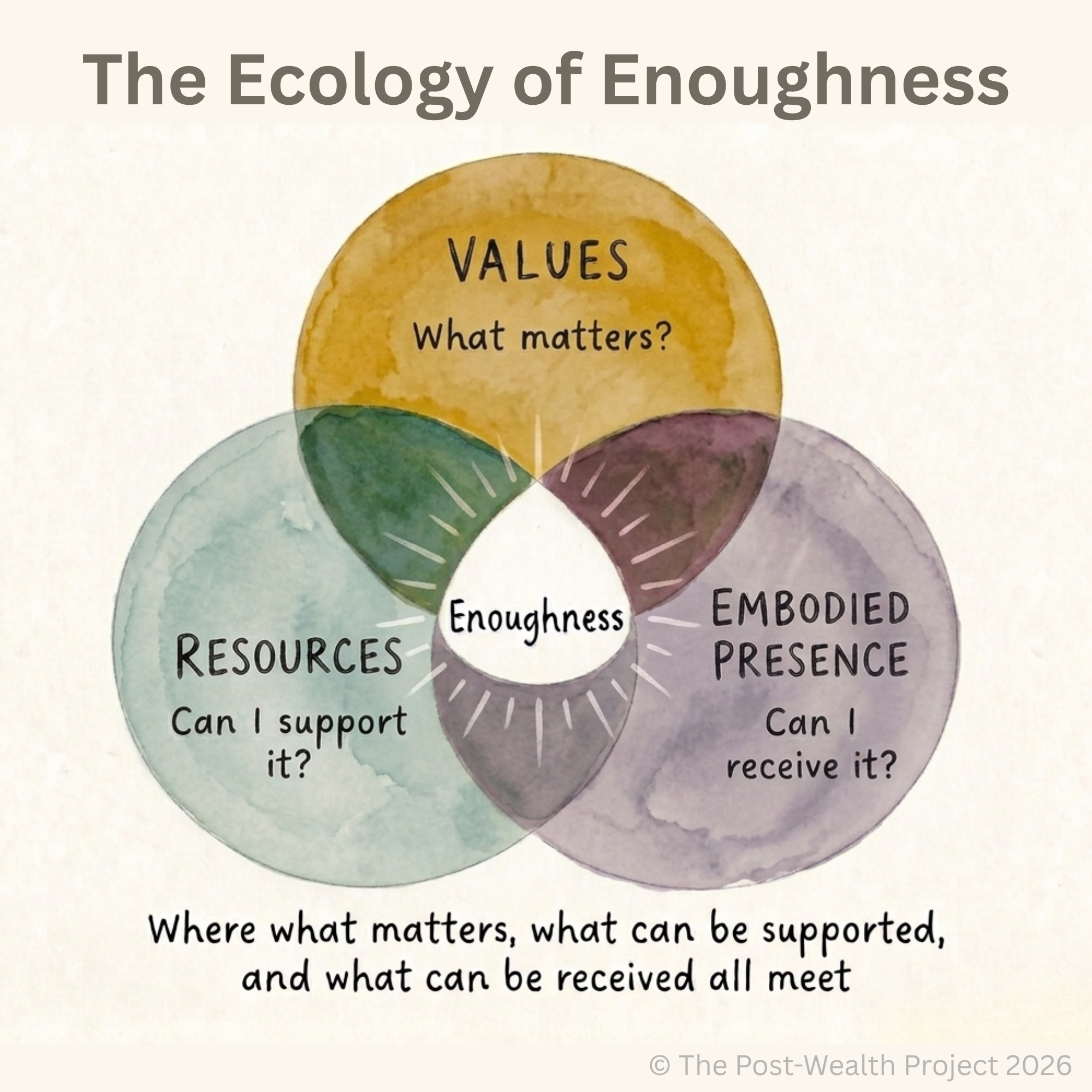
Illustration titled "The Ecology of Enoughness." A three-circle Venn diagram shows the relationship between Values, Resources, and Embodied Presence. The top gold circle is labeled "Values – What matters?" The left blue-green circle is labeled "Resources – Can I support it?" The right purple circle is labeled "Embodied Presence – Can I receive it?" At the center where all three circles overlap is a white shape labeled "Enoughness," surrounded by radiating lines. Beneath the diagram, the caption reads: "Where what matters, what can be supported, and what can be received all meet." The overall design uses soft watercolor textures and includes the watermark "© The Post-Wealth Project 2026."
What’s Next
Over the next few weeks, I’ll be exploring each of these three dimensions: our resources, our values, and the realities of the lives we actually have.
Alongside the essays, I am offering a workbook. This workbook will allow you to explore your values, your resources, and the realities of your life—not to arrive at a perfect answer, but to better understand what enough means for you. You can get this workbook here or by becoming a paid subscriber on Substack.